Google’s Art & in Miniature
Have you ever wondered about Google’s iconic logo that changes when recognizing celebratory events and holidays? It can all be attributed to one man in particular but more importantly to technology, not surprising.

Thomas Williams is the senior engineering director for Google and recent site manager of their new Venice Beach campus. While studying computer science at Villanova University he designed a software performance tool called “gnuplot” which produces graphs based on scientific data. This is still used by many universities, scientists and businesses today including Google. Williams states what he learned, “was, to find something that was really useful and make it really simple for anyone to use.” He later went on to work for Steve Jobs and Pixar working with their unique computer graphics. From this he worked for George Lucas’ Industrial Light and Magic firm to help produce some of the visual effects with digital animation code for Star Wars, among other films. He discovered from his experience here when seeing how some of the original artwork was produced in a non-technical, traditional way like painting. Williams created technology to replicate the more natural rendition of traditional painting which transformed the efficiency and natural look for film production.
In addition to this “new” technology, I found his work model very inspiring. As he is a master carpenter, in building with his hands, he’s learned to solve building problems as he goes. He cites the same technique for his employees:
“It’s personal expression. People don’t think of writing a program the same way as they do writing a book or poem, but it’s a creative process….” Instead of allowing employees to get mired in jobs that become endlessly repetitive — like hamster wheels — you get them to “build their own treadmills.” That means giving people the latitude to figure out problems in new ways and to work at their own pace. “If you work with great people, everyone is setting their treadmill too high. No one’s telling you you’re not going fast enough — everyone is telling themselves that.”
Here was another article, The Creative Side of Doing Nothing Online, that I thought was another insightful article about how those who search the Internet derive their creativity from their online experience because of their discovery they find during their leisurely online searching. This can be an everyday experience for a lot of us. How often have you been distracted while just looking up one thing.
The Web has given rise to a formidable and pervasive culture of creativity, in large part because it encourages people to experiment in the guise of having fun. And, perhaps more important is what the study found about who is not going online for fun, and who is thereby losing out on the lessons of experimentation and creativity….The Web has given rise to a formidable and pervasive culture of creativity, in large part because it encourages people to experiment in the guise of having fun. And, perhaps more important is what the study found about who is not going online for fun, and who is thereby losing out on the lessons of experimentation and creativity.
I have found so many artists through random online searches that the list seems endless — all of whom I’d like to profile. Jane Kenoyer is just one but I really like her illustrated style artwork for her pendant style paintings — very beautiful and all pertaining to the female figure as the heroine and influenced by her great-grandmother Pearl.

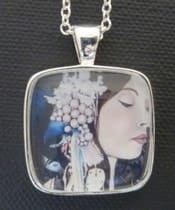
Her work reminds me or Erté and also of Giovanna Cassanelli, the artist who’s pendant I purchased within the Vatican. She paints famous Italian female portraits in miniature. She was the only painter selling their hand-painted wares within the walls of the Vatican that I noticed and she was extremely talented. She must have been in her late 60’s then (over 10 years ago) so I wonder if she is still there or around. I hope so but if not, I feel as if some of her handiwork has lived on in the small treasure that I had just happened to discover while in Rome.


casart
I'm an artist, wife and mother of two boys. I started my illustration business, The Occasional Palette over 35 years ago, when my oldest son was an infant. Once my children were in school, I began painting decorative, faux finishes and murals through my second business, Casart, now over 30 years old. My third business, Casart Coverings, is a springboard from my second. Click on the link on the sidebar to see innovative, custom, designer wallcovering, removable and reusable wallpaper and coordinating decor.

4 Comments
Jacqueline
I also have a couple of pendant/portraits from Giovanna Cassanelli that I treasure. After doing some research I am very sad to have found out that she has passed away. Her beautiful art lives on and will be a treasure in my family for years to come.
casart
Hello Jacqueline,
Thank you so much for your comment! Of course I’m sad to hear that Giovanna Cassanelli has passed away, but I appreciate knowing. I’m glad to hear someone else appreciates her artwork and to know her talent lives on in the treasures we have as keepsakes of her work.
Vivian Castro
Hello and thank you for the information. I have 2 brooches that i acquired from Giovanna Cassanelli and I am interested in selling them but unfortunately I cant come up with a fair market value for them and now that I know she passed i would assume the prices have gone up. Can you help me with the value of these gorgeous pieces of art?
casart
Hello Vivian,
Many thanks for your comment. I’m so sorry that Giovanna had passed away. In light of this information, I’m even more glad that I have one of her pieces. I haven’t looked into, nor would I want to sell it, so unfortunately, I can’t really help you per your request. However, I would do a simple search on auction sites that may list her pieces, like this one to give you some sort of idea of their value: https://www.bidsquare.com/online-auctions/kamelot-auction-house/pr-italian-portraits-giovanna-cassanelli-brooch-1326752. I wish you the best of luck in your quest.