Math, Art & Science Connection
I believe there is a direct connection between art, math and science. Why, not because my last post proves the point on another level, but because artists think analytically, from how to get to point A (blank canvas for instance) to point B (painted artwork) and construct this process and composition for getting there. This often requires subconscious, abstract mathematical and scientific thinking.
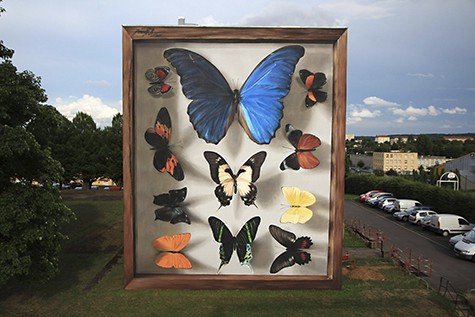
The following articles further explain this interesting concept. Jesse Rosten explains using his fascination (mine too) with butterflies as an example in his article, Art & Science, that art would not exist without science and conversely, new scientific discoveries happen through creativity. [Love these butterflies. They remind me of some that I’ve painted.]

Interesting that I found this next post, Math and Art in Education, from the Northwest Progressive Institute Advocate, a “liberal perspective on world, national and local politics.” I normally pass on political blogging because I’m surrounded by it daily in DC. I’m progressive enough, however to reflect on what might be views contrary to my own. I agree with this perspective, however, and there’s a lovely drawing of Waikiki Beach to view here, as well:
We tend to view students in two very broad categories: “artistic” kids and “intellectual” kids. This is a crass generalization, but it’s true. Society, by and large, expects people to be one or the other. Rarely both.
Which is to say that there is not an expectation that an artistic kid will be any good at math, science, or engineering. Nor is there any expectation that intellectual kids should have any interest in or aptitude for art.
Frankly, I think that’s crap. I think that every kid has a creative side regardless of their skills in the sciences. And I think that every kid has an analytic side, regardless of their skills in the arts.
And I know, because I’ve lived it myself, that math and art can reinforce one another. Math can be used to teach art and strengthen one’s creative side. The desire to make art can be used as a springboard from which to teach math.
The Secret Art of Math is discussed in The Irish Times. I’ll have to check out the book The Secret Mathemaeticians as well, which describes how artists have used math in their creative process. You can watch the webcast of the presentation here.
The Chicago Art Magazine also explores the relationship between scientist and artist. Daniel Nolan was a nuclear engineer before he decided to become a resin painter, for example. He describes the original idea can be obtained by both artists and scientists but the difference is how it is applied in their work. Why, even the Lego exhibit is discussed in this article, which brings me full circle back to my belief that Legos have built the foundation for my son’s engineering career path.

Finally, I found my Kick Start your Weekend music, coincidentally, from a YouTube video of Marc Spijkerboch’s painting, who I posted on previously, and who must also happen to like Radiohead. Here’s his work filmed to Radiohead’s “All I Need.”

casart
I'm an artist, wife and mother of two boys. I started my illustration business, The Occasional Palette over 35 years ago, when my oldest son was an infant. Once my children were in school, I began painting decorative, faux finishes and murals through my second business, Casart, now over 30 years old. My third business, Casart Coverings, is a springboard from my second. Click on the link on the sidebar to see innovative, custom, designer wallcovering, removable and reusable wallpaper and coordinating decor.