Pushing the Boundaries of Public Art
I came across several news stories recently that indicate that there is pushing the boundaries of public art in various cities. I thought I’d piece a few together and let you decide because it is ultimately up to the viewer to determine if they like or dislike the artwork they are viewing.
The controversy exists when the artist pushes their artwork on the people. If the artwork was a private commission or for private viewing, in a museum or a gallery where pieces can be purchased, it would be different because the artist is more free to push the boundaries with their personal expression.
Public murals have always been controversial. I’ll be the first to admit that I don’t like a lot of generic graffiti art, but I appreciate where talent is noticeable.
If you’re creating public art that ‘lives’ in others’ spaces then I think you have to be respectful of the community since its very definition is based on a shared living space. Definition: is a “unified body of individuals.”
: a group of people who live in the same area (such as a city, town, or neighborhood)
: a group of people who have the same interests, religion, race, etc.
These two public art murals are causing an uproar in Atlanta. I posted about one of them already. There was a documentary on PBS that features the controversy and “the balance between art and community.” Here’s the trailer. The film can be watched this week.
This debate is not isolated to Atlanta. Other cities have seen their fair share with Bansky and Shepard Fairey and other street artists.
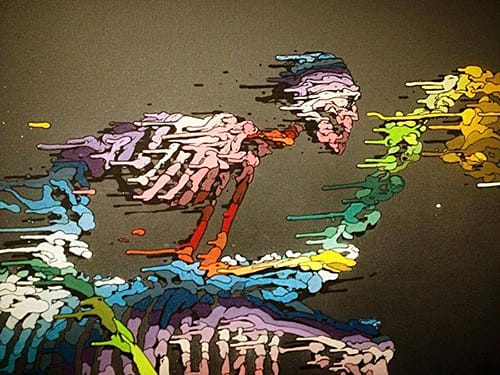
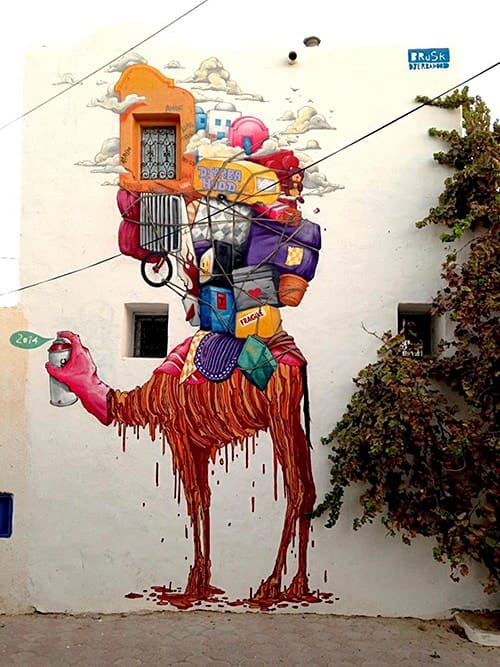
I’m not sure how Brusk, a French street artist, deals with where and when he paints or with permission but I like his work.

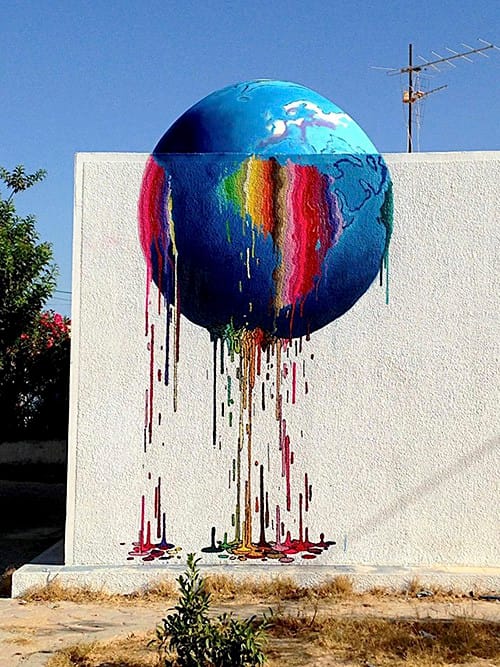
His illustration style and art education at the Ecole des Beaux – Arts de Saint Etienne clearly displays his talent. Sometimes his subjects are a little jarring but his style is pretty mesmerizing with its interplay between 3D painting and sometimes sculpture.
Perhaps interactive art, where the community is abiding and has been consulted in the dialogue before and / or even after, is a better approach.
INSA’s app for viewing his murals on site and making them move or become interactive with the viewer is one example.

Getting the community involved for a worthwhile project becomes a beneficial reason for public murals, such as this “Home Safe” mural that comprise 2 walls and is sponsored by the well-known Philadelphia Mural Arts Program. It is painted in West Philadelphia to pictorially show potentially circuitous paths homeless youth take n the city just to get home — to a safe place. The mural painted by the “Journey to Home” team gives the homeless teens who painted it a path for work, expression and community pride.
Like other typical graffiti murals it uses many spray painted words but the composition, color and overall execution is cohesive, just like the painters and the neighborhood on board with this public mural.

Interesting also that I read about “moving murals in the red stick” on the Nola Defender blog, which discusses:
“…designing and building the “flexible and modular” system [in Baton Rouge, LA, the “red stick”]. The rotating exhibit is intended to serve as shifting, interactive space that will showcase a visual display of the unique identity of a city and its residents…“It’s the idea of taking a mural and pushing the boundaries, not being permanent,” Doran, [Professional in Residence, at the LSU school of Architecture], said. “A mural is just sort of a static image and we want to make it become more interactive and engaging and something for the community to enjoy.”
They are taking the right approach where all parties collaborate, as quoted here:
” LSU students, enrolled in the 2014 Mid City studio class, are creating the architectural mural with the help of several businesses in Baton Rouge as well as The Walls Project. Friday’s (10.10) soiree will be focusing on receiving input from the community on the project as well as raising support for the project.”

It will be interesting to see how this comes out. Maybe it can ‘move’ to Nola next where I can actually see it when I’m back ‘home.’
When it comes to interactive murals, I can’t think of a better one that gets you moving, as the Berkley Beacon describes, with a Red Rock Wall and inspirational quotes by “Marshall McLuhan, [a Canadian philosopher], as “a way to share relevant literature without being annoying.”
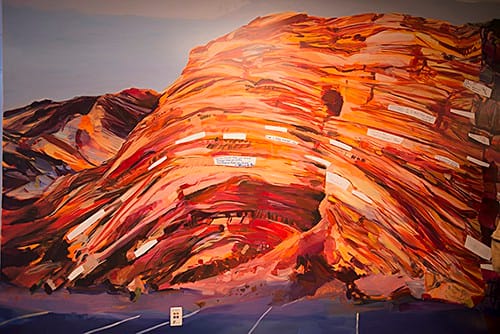
The mural is called, “A Coney Island of the Mind—Marshall McLuhan, and painted by Julia Cseko on Berkley’s student campus. There are 2 other murals to be painted as part of the project:
Blazejack said she was paid $3,000 to paint the mural on the fifth floor of Paramount, Rock Wall for Sedimentary Drawing, and said the rock featured in the painting was a metaphor.
“These layers of sedimentary rock, compressed over millions of years, were made with layers of paint set down quickly,” Blazejack explained. “It represents the history of the school, and all these students moving through and graduating.”
Blazejack purposefully left square blank spaces throughout the mural for students to leave their own legacies.
Note: Sorry, for some reason, this post missed it’s schedule from last week.

casart
I'm an artist, wife and mother of two boys. I started my illustration business, The Occasional Palette over 35 years ago, when my oldest son was an infant. Once my children were in school, I began painting decorative, faux finishes and murals through my second business, Casart, now over 30 years old. My third business, Casart Coverings, is a springboard from my second. Click on the link on the sidebar to see innovative, custom, designer wallcovering, removable and reusable wallpaper and coordinating decor.